


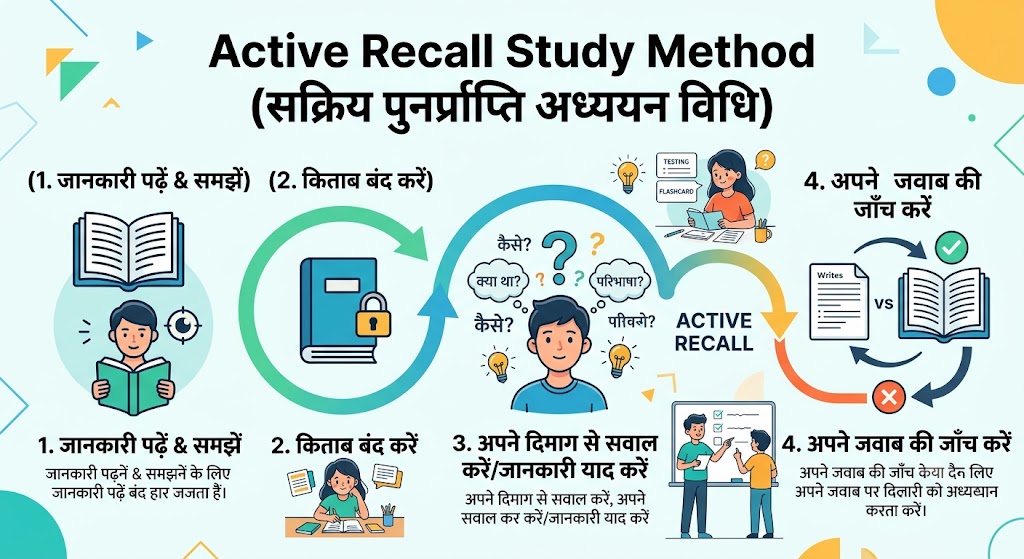
Active Recall Study Method 2026: Learn Smarter and Retain More
Active recall study method: spend hours rereading notes, highlighting textbooks in three colors, and rewatching lecture videos, only to blank out during the actual exam. It’s not a lack of effort. It’s that rereading feels productive without actually building the kind of memory that survives under pressure. That gap between “I studied for six hours” and “I can’t remember any of it” is exactly what pushed so many learners, teachers, and even corporate trainers toward a different approach in 2026.
The active recall study method has quietly become one of the most talked-about learning strategies of the decade, not because it’s new- cognitive scientists have known about it for over a century- but because more people finally understand why it works and how to actually use it. This article walks through the science, the techniques, the routines, and the real-world examples that make this approach worth building into your study life, whatever you’re trying to learn.
By 2026, the active recall study method around studying smarter has shifted well beyond a niche corner of educational psychology. Teachers, tutors, and workplace trainers now openly recommend retrieval-based habits over the highlighter-and-reread routine that dominated classrooms for generations, and the reason comes down to a simple, well-tested idea: memory strengthens through effort, not exposure.
The Science of Memory Retrieval and Why It Works

Memory doesn’t work like a filing cabinet where information sits quietly until you need it. It works more like a muscle. Every time you pull a piece of information out of your brain, rather than just looking at it again, you strengthen the neural pathway that stores it. This is the entire premise behind the active recall study method, and it’s backed by decades of cognitive psychology research, not just internet folklore.
How the Brain Strengthens Memories Through Retrieval
When you try to remember something without looking at the answer first, your brain has to search through stored information, make connections, and reconstruct the memory from partial cues. That struggle is uncomfortable, and it’s exactly the point. Neuroscientists refer to this as retrieval practice, and studies going back to the 1990s have consistently shown that the effort of pulling information from memory strengthens it far more than simply re-exposing yourself to the same material.
Active recall study method that is to reread a paragraph for the fourth time. Your eyes move across familiar words, your brain recognizes the shapes and patterns, and you feel a false sense of familiarity that gets mistaken for actual knowledge. That’s the trap. Recognition is not the same as recall, and exams almost always test recall, not recognition.
Passive Review vs. Active Engagement
Active recall study method, rereading, highlighting, watching videos on 1.5x speed, feels productive because it’s low effort and comfortable. Unfortunately, comfort and learning don’t correlate the way most students assume. A well-known study published in the journal Science found that students who tested themselves on material outperformed students who reread the same material multiple times, even though the rereading group spent more total study time.
This is the core distinction that separates people who cram and forget from people who genuinely retain what they learn. Study techniques built around retrieval consistently beat those built around passive exposure, across nearly every subject researchers have tested, from vocabulary lists to complex medical concepts.
The Psychology Behind Retrieval Practice
Understanding why this method works isn’t just academic trivia. It changes how you actually design a study session, and it explains why some approaches that feel harder in the moment produce better results down the line.
The Testing Effect Explained
The phenomenon behind the active recall study method has a formal name in psychology circles: the testing effect. Researchers Henry Roediger and Jeffrey Karpicke ran a now-famous 2006 study where students who took a practice test on a reading passage remembered significantly more of it a week later than students who reread the passage multiple times, even though the reread group initially felt more confident about their knowledge.

That confidence gap matters. It’s part of why so many students underestimate how much they’ve forgotten until they sit down for the real exam. Testing yourself, even informally, closes that gap by showing you exactly what you actually know versus what merely feels familiar.
Desirable Difficulty and Deeper Learning
Psychologist Robert Bjork coined the term desirable difficulty to describe learning conditions that feel harder in the short term but produce stronger, longer-lasting memories. Struggling to recall an answer, getting it wrong, and then correcting yourself creates a deeper memory trace than simply being handed the correct answer immediately.
This is uncomfortable advice for a lot of learners, because it means the study sessions that feel the smoothest are often the least effective ones. A little productive struggle, the kind built into self-testing and practice questions, tends to produce far better long-term results than a study session that feels effortless from start to finish.
Practical Techniques for Stronger Recall
Knowing the theory is one thing. Actually building a study routine around it is where most people get stuck. Here are the techniques that consistently show up in research and in the habits of high-performing students and professionals alike.
Flashcards and Spaced Repetition Systems
Flashcards are one of the oldest tools in education, but the way modern learners use them has changed considerably. Digital flashcard apps built around spaced repetition algorithms show you a card right before you’re likely to forget it, rather than at a fixed daily interval. This timing matters enormously. Reviewing something too early wastes effort on material you already know well. Reviewing it too late means you’ve already forgotten it and have to relearn it from scratch.

Popular spaced repetition platforms track how well you know each card and adjust the review schedule automatically, pushing well-known cards further out and struggling ones back sooner. This pairing of retrieval and timing is one of the most well-supported combinations in all of learning science.
Self-Quizzing and Practice Questions
Not every subject lends itself to flashcards, and that’s fine. Self-quizzing through practice questions works just as well, sometimes better, especially for subjects involving problem-solving rather than pure memorization. Closing your textbook and writing out everything you remember about a topic, then checking it against your notes, forces the exact kind of retrieval effort that builds durable memory.
Past exam papers, end-of-chapter questions, and even questions you write yourself all serve this purpose. The key isn’t the source of the questions. It’s the act of answering without peeking at the material first.
The Blank Page Technique
One of the simplest versions of the active recall study method requires no app, no flashcards, and no special tools at all. Take a blank sheet of paper and write down everything you remember about a topic from memory, in as much detail as possible. Only after you’ve genuinely run out of things to write do you go back to your notes and fill in the gaps.

This method exposes exactly where your understanding is thin. Most students are surprised, and a little humbled, by how much less they can recall than they expected. That discomfort is useful information, not a failure.
Teaching Concepts to Others
Explaining a topic out loud, to a study partner, a sibling, or even an empty room, forces you to organize your knowledge in a way that passive review never demands. This is sometimes called the Feynman Technique, named after physicist Richard Feynman, who believed that if you couldn’t explain a concept simply, you didn’t understand it well enough yet.
Teaching forces retrieval, exposes gaps in logic, and requires you to translate technical language into plain terms, all of which deepen understanding far beyond what rereading a textbook chapter accomplishes.
Combining Retrieval Practice With Other Learning Habits
No single technique needs to work in isolation, and treating retrieval as the only tool in the toolbox can actually limit its effectiveness. The most successful learners tend to layer it alongside other evidence-based habits, using each one for what it does best.
Pairing Recall With Spaced Practice and Interleaving
Spacing and interleaving are close cousins of retrieval practice, and together they form a genuinely powerful combination. Spacing means reviewing material at increasing intervals rather than all at once, while interleaving means mixing different topics or problem types within a single study session instead of grouping similar ones. A student practicing math might, for instance, mix algebra and geometry problems in the same session rather than working through fifty algebra problems in a row. This forces the brain to identify which type of problem it’s looking at before solving it, a small but meaningful extra layer of retrieval that strengthens understanding beyond what either technique would achieve alone. The active recall study method becomes noticeably more powerful once it’s combined with this kind of deliberate spacing and mixing, rather than applied as a single isolated habit.
Using Summarization and Concept Mapping Before Retrieval Begins
Techniques like summarizing a chapter in your own words or building a concept map work well as a first step, organizing raw information into something more structured. Retrieval practice then takes over from there, testing whether that structure actually stuck. Used in the wrong order, these techniques offer little benefit; skipping straight to retrieval before you’ve made any sense of the material at all usually just produces frustration rather than learning. Used in the right sequence- organize first, then retrieve repeatedly- they reinforce each other in a way that neither manages alone.
Building a Daily Routine Around Retrieval Practice
Techniques only matter if they turn into consistent habits. A single flashcard session the night before an exam won’t produce the same results as a routine built around regular retrieval over weeks or months.
Structuring Your Study Schedule
A strong routine usually blends new learning with review of older material, rather than treating them as separate phases. A common structure looks something like this:
- Spend the first part of a session learning new material through reading or lectures
- Immediately follow with a short retrieval attempt on that same material
- Dedicate a separate block of time to reviewing older material using spaced repetition
- End sessions with a quick self-quiz covering everything studied that day
This structure keeps older knowledge fresh while still making room for new learning, which prevents the common trap of moving forward so fast that earlier material quietly fades away.
Tools and Apps Worth Using
A wide range of digital tools now support this kind of studying, from dedicated spaced repetition apps to simple note-taking software with built-in quiz features. Most effective tools share a few common traits: they let you create your own questions rather than relying only on pre-made content, they track your performance over time, and they automatically adjust review timing based on how well you know each item.
That said, low-tech methods work just as well for plenty of learners. A stack of index cards and a notebook can support a fully functional active recall study method without any subscription or app download required.
Tracking Progress and Adjusting Over Time
Retrieval practice generates useful data about your own learning, if you pay attention to it. Consistently missing questions on a specific topic tells you exactly where to focus more time. Consistently getting something right without hesitation tells you it’s safe to review less often.

A few habits help here:
- Keep a simple log of which topics you struggle with across multiple sessions
- Revisit weak areas more frequently than strong ones, rather than treating all material equally
- Adjust review intervals based on actual performance, not a fixed calendar
- Periodically mix topics instead of studying one subject in isolation, since this interleaving strengthens the ability to distinguish between similar concepts.
Advantages Over Traditional Studying
There’s a reason this approach has gained so much traction heading into 2026, especially among students juggling limited time and high expectations.
Stronger Long-Term Retention
The most obvious advantage is durability. Information learned through long-term retention techniques like retrieval practice tends to stick around for weeks, months, or even years, rather than evaporating within days of an exam. This matters enormously for cumulative subjects like language learning, medicine, or licensing exams, where earlier material keeps showing up later.
Time Efficiency
It might seem counterintuitive that a harder method could also be more time-efficient, but research supports exactly that. Students using retrieval-based study routines often need less total study time to reach the same, or better, level of mastery compared to students relying on rereading and highlighting. The effort spent recalling information does more per minute than the effort spent passively reviewing it.
Better Performance Under Exam Pressure
Exam preparation built around retrieval mirrors the actual conditions of test-taking far more closely than passive review does. An exam asks you to produce answers from memory under time pressure, not to recognize familiar-looking notes. Practicing retrieval repeatedly builds exactly the skill the exam will demand, which is part of why students using this approach frequently report feeling calmer and more confident walking into a test.
Real-World Examples Across Different Learners
Theory is useful, but seeing how this plays out for real learners makes the value much clearer.
Medical Students Preparing for Board Exams
Medical education involves an enormous volume of material that all needs to be retained simultaneously, not just learned and forgotten module by module. Many medical schools and independent prep programs now build their entire curriculum around spaced, retrieval-based question banks rather than traditional textbook review, precisely because the volume of material makes passive rereading practically useless. Students working through thousands of practice questions over months, rather than rereading textbooks in the weeks before an exam, consistently report stronger recall and less last-minute panic.
Language Learners Building Vocabulary
Vocabulary acquisition is one of the clearest success stories for this approach. Popular language learning apps have built their entire product around spaced flashcard review precisely because vocabulary retention responds so well to retrieval practice. Learners who quiz themselves on new words, rather than simply rereading vocabulary lists, tend to retain significantly more words after several weeks, even when total exposure time is similar.
Professionals Studying for Certifications
Working adults preparing for professional certifications, whether in finance, project management, IT, or other fields, often have far less study time available than full-time students. This makes efficiency especially valuable. Practice question banks and self-testing routines let professionals make the most of limited evening or weekend study sessions, producing stronger results per hour invested compared to passively rewatching training videos.
High School and College Students Preparing for Standardized Tests
Standardized testing, whether it’s a college entrance exam or an end-of-year subject test, rewards exactly the kind of retrieval skills this approach builds. Students who spend the weeks before a big test working through timed practice questions, rather than rereading review books cover to cover, tend to walk in with a clearer sense of which topics still need work. Teachers who have shifted classroom review sessions toward low-stakes quizzing, instead of lecture-style recaps, often report that students retain material from earlier units far better heading into cumulative exams. The active recall study method fits naturally into this kind of test preparation because it mirrors the actual format of the exam itself: questions that demand an answer pulled from memory, not a multiple-choice hint that jogs recognition.
Mistakes That Undermine Retrieval Practice
Even a genuinely effective method can fall flat if it’s applied poorly. Plenty of students believe they’re practicing the active recall study method correctly when, in reality, they’ve slipped back into habits that undo most of the benefit. A few common mistakes show up again and again.
- active recall study method
- Only reviewing material you already know well, because it feels more satisfying, while avoiding the topics you actually struggle with
- Cramming all retrieval practice into a single session right before an exam instead of spacing it out over time
- Using recognition-based tools, like multiple-choice quizzes with obvious answers, as the only form of testing, which doesn’t demand true recall
- Skipping the correction step after getting an answer wrong, which wastes the most valuable part of the entire process
Avoiding these pitfalls matters just as much as adopting the technique in the first place. A weak version of retrieval practice, done carelessly, won’t produce the results that make this approach worth the extra effort.
Why This Approach Scales Across a Lifetime of Learning
One of the most underrated qualities of this method is how well it scales, both across different subjects and across an entire lifetime of learning, not just a single semester or exam season.
From Classroom Habits to Lifelong Skills
Students who build strong retrieval habits early tend to carry them forward into active recall study methods, where ongoing learning never really stops. Someone who learned to quiz themselves on history dates in high school can apply the same underlying principle to learning new software, absorbing industry regulations, or picking up a new language as an adult. The specific content changes constantly. The underlying skill of retrieval-based learning doesn’t.
Applying It Across Any Subject
Active recall study methods that only work well for specific types of content; this approach adapts easily across nearly any subject matter. Mathematical problem-solving, historical dates, foreign vocabulary, medical terminology, legal case law, coding syntax- none of these are fundamentally different when it comes to how memory forms and strengthens. The format of the retrieval practice changes- flashcards for vocabulary, practice problems for math- but the underlying principle stays identical.
A Habit That Compounds
Active recall study method’s most valuable long-term benefit is how this approach compounds over time. Each retrieval session doesn’t just reinforce a single fact. It strengthens a broader habit of engaging actively with material rather than passively consuming it, a habit that pays dividends across every future learning challenge, from a college degree to a career change decades later. This is where the real, lasting value of the active recall study method becomes clear. It’s not a one-time trick for a single exam. It’s a foundational skill that scales with you, getting more valuable the more consistently it’s applied across different subjects, career stages, and personal learning goals.
How to Know Your Retrieval Practice Is Actually Working
active recall study method to assume a technique is working simply because it feels harder than passive review, but effort alone isn’t proof of results. There are a few practical signs worth watching for.
Signals That Point to Real Progress
The clearest sign that the active recall study method is paying off is being able to answer questions correctly after a gap of several days or weeks, not just minutes after first learning the material. Short-term recall right after a study session tells you almost nothing, since nearly any study method produces decent results immediately afterward. The real test comes later, when the material has had time to fade a little and genuine memory strength gets revealed.
Adjusting the Approach When It Isn’t
active recall study method consistently feels too easy, that’s often a sign intervals are too short, and material is being reviewed more often than necessary, wasting time that could go toward weaker topics. If sessions consistently feel overwhelming, with most answers coming up blank, that can mean too much new material was introduced before earlier content had a chance to settle. Adjusting the pace, rather than abandoning the method entirely, usually solves both problems. Tracking accuracy over time, even with a simple notebook or spreadsheet, makes these patterns much easier to spot than relying on a vague gut feeling about how studying is going.
Key Points to Remember
- The active recall study method relies on retrieval, not rereading, to actually strengthen long-term memor.y
- Struggling to recall information, even getting it wrong, builds stronger memory than passive exposure. re
- Spaced repetition improves timing so review happens right before forgetting occ.urs
- Self-testing, teaching others, and the blank page technique are all effective, low-cost ways to practice retrieval.
- active recall study method
- This approach saves time overall, even though individual sessions may feel harder.
- The underlying skill transfers across subjects and stays useful well beyond school.l
Getting Started This Week: A Simple First Step
None of this requires a complete overhaul of how you study starting tomorrow. The easiest way to begin applying the active recall study method is picking one subject you’re currently working through and, at the end of today’s session, closing your notes and writing down everything you remember before checking what you missed. That single small change, done consistently for a week, tends to reveal more about actual understanding than months of passive rereading ever did.
From there, the routine can grow gradually. Add a set of flashcards for vocabulary or key terms. Introduce a weekly self-quiz covering everything studied that week rather than just the most recent material. Try explaining a tricky concept out loud to a friend, a study partner, or even a pet who won’t interrupt with questions. Each addition builds on the last, and none of them require expensive tools or a dramatic schedule change.
What matters most is starting somewhere and staying consistent rather than waiting for the perfect system before beginning. Learners who adopt even one piece of the active recall study method tend to notice a difference within the first couple of weeks, which usually provides enough motivation to keep building the habit further. The goal isn’t perfection on day one. It’s steady, repeated practice that compounds into genuinely durable knowledge over time, the kind that survives long after the highlighter runs dry.
Final Thoughts about active recall study method
active recall study method the same as studying smarter, and for a long time, a lot of well-intentioned students confused the two. Hours spent rereading notes can feel productive without actually building memories that survive the pressure of a real exam or a real professional situation. The active recall study method offers something different: a way of engaging with material that’s a little more uncomfortable in the moment but produces results that last far longer and require less total time overall.
Whether you’re a student prepping for finals, a professional studying for a certification, or someone learning a new language just for the joy of it, the underlying principle stays the same. Pull information out of your memory before you look at the answer. Struggle a little. Correct yourself. Repeat that process consistently, and the knowledge sticks in a way that passive review simply never manages to achieve.
FAQs
Is the active recall study method suitable for young students, or mainly for adults? It works active recall study method, though the format needs to match the learner. Younger students often respond well to simple flashcards and verbal quizzing, while older students and professionals can handle more complex practice questions and self-testing formats.
How long does it take to see results from switching to retrieval-based studying? Many learners notice a difference within a few weeks, particularly in how much they retain a week or two after learning something, using the active recall study method, compared to their previous rereading habits. The full benefits tend to compound over months of consistent practice rather than appearing overnight.
Can this method be combined with other study techniques like mind mapping or summarizing? Absolutely. Techniques like mind mapping can help during the initial learning phase, while retrieval practice works best afterward, as a way of reinforcing and testing what’s already been organized. The two approaches complement each other rather than competing.
Does this study method require expensive apps or subscriptions to work effectively? Not at all. While digital spaced repetition apps offer convenience, the core method works just as well with plain index cards, a notebook, or even a study partner willing to quiz you out loud. The technique matters far more than the tool used to apply it.