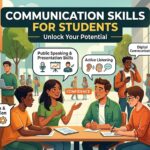


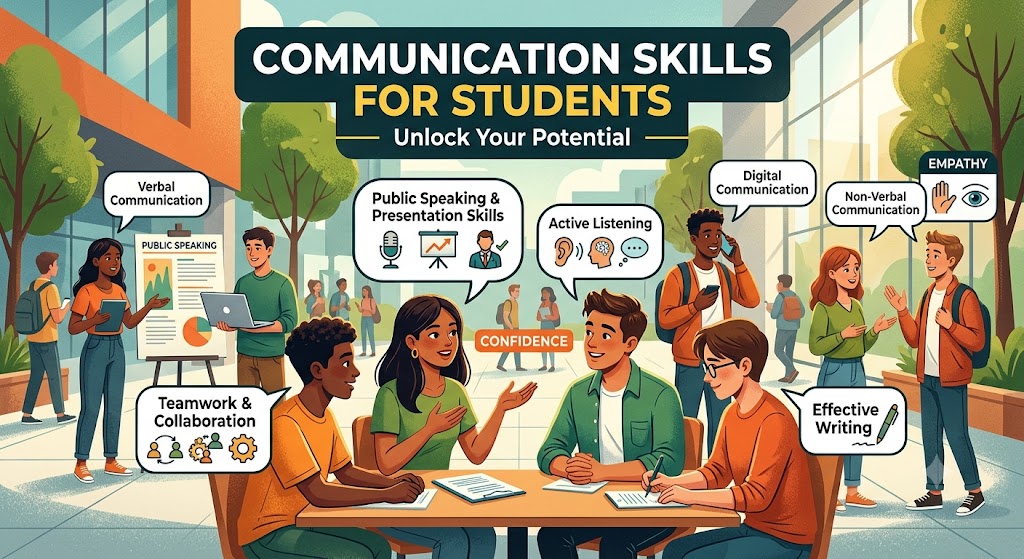
The way young people learn, connect, and grow is changing faster than ever, and at the center of this shift lies one timeless requirement for success. Developing strong communication skills for students is no longer optional — it is a core life skill that shapes academic performance, career readiness, and personal relationships. In classrooms, group projects, virtual meetings, and even casual conversations, the ability to express ideas clearly and listen with intent separates confident learners from those who struggle to be understood.
As communication skills for students become more hybrid, collaborative, and technology-driven, students are expected to communicate across multiple platforms — face-to-face, on video calls, through emails, and on collaborative apps. This makes it essential for every learner to build a well-rounded communication toolkit early on. In this article, we explore twelve practical, modern, and highly effective communication abilities every student should master in 2026, along with real examples, benefits, and actionable tips to strengthen each one.
Why Communication Skills Matter for Students in 2026
Modern classrooms have evolved into dynamic ecosystems where learners interact with peers, teachers, and digital tools simultaneously. Strong verbal communication and written expression directly influence how well a student performs in presentations, exams, interviews, and teamwork activities. Employers, universities, and scholarship committees consistently rank interpersonal ability among the top qualities they look for, right alongside academic grades.

Beyond academics, the value of effective expression extends into everyday life. Students who articulate their thoughts well tend to build stronger friendships, resolve misunderstandings faster, and handle stress more effectively because they can voice their needs instead of bottling them up. This is precisely why building communication skills for students has become a priority for schools, parents, and career counselors alike heading into 2026.
The shift toward digital-first education also means that traditional classroom etiquette alone is no longer enough. A student who can only speak confidently in person but freezes during a video call, or who writes well in essays but struggles to draft a professional email, has only built half the skill set needed for 2026 and beyond. This is why a holistic approach to communication skills for students — one that spans spoken, written, digital, and emotional dimensions — is far more valuable than focusing on just one channel.
Key Benefits of Strong Communication Abilities
Before diving into the twelve core skills, it helps to understand why this investment pays off so significantly across a student’s life.
- Academic performance improves when students can ask better questions, explain concepts to classmates, and participate confidently in discussions.
- Career readiness increases because interviews, internships, and networking events all hinge on how well a candidate presents themselves.
- Emotional wellbeing benefits from the ability to express feelings, set boundaries, and seek help when needed.
- Leadership potential grows naturally, since leaders are often defined by their ability to inspire and guide others through words and actions.
- Conflict reduction happens organically when students learn to communicate needs and disagreements respectfully rather than through avoidance or aggression.
These advantages highlight just how far-reaching the impact of good communication truly is, making it a foundational skill rather than a soft extra.
1. Active Listening
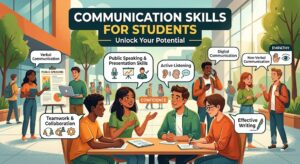
Communication skills for students are the foundation of every meaningful conversation, yet it is often the most overlooked skill in a student’s toolkit. It means giving full attention to a speaker, absorbing their message, and responding thoughtfully rather than simply waiting for a turn to talk. This is one of the most underrated forms of communication skills for students, because listening well often matters more than speaking well.
Example: During a group study session, a student who practices active listening will nod, ask clarifying questions like “So you’re saying the formula changes when the variable is negative?”, and paraphrase what a peer said before responding.
Key points to build this skill:
- communication skills for students
- Paraphrase what you heard before replying.
- Avoid interrupting, even when you disagree.
- Ask open-ended follow-up questions.
Research on classroom engagement consistently shows that students who practice active listening retain information longer and participate more confidently in discussions, because they are processing ideas in real time rather than simply waiting for their turn to speak. Teachers often notice this difference immediately: a student who listens closely tends to ask sharper, more relevant questions, which in turn deepens their own understanding of the material. Building this habit early makes every other communication skill on this list easier to develop, since listening is the raw material from which thoughtful responses are formed.
2. Public Speaking and Presentation Skills
Standing in front of a classroom or a panel of judges can feel intimidating, but public speaking is a skill that improves dramatically with structured practice. Strong presentation skills allow students to share ideas confidently during debates, seminars, thesis defenses, and extracurricular competitions.
Example: A student presenting a science fair project who uses a clear structure — introduction, problem, method, results, conclusion — paired with confident body language, will leave a far stronger impression than one who simply reads from notes.
Advantages of mastering this area:
- Builds self-confidence in high-pressure situations.
- Improves persuasive ability during debates and pitches.
- Prepares students for future job interviews and workplace meetings.

Many students assume public speaking talent is something people are simply born with, but in reality it is one of the most trainable areas within communication skills for students. Small, repeated exposure — presenting to a mirror, practicing in front of family, or volunteering for short in-class updates — gradually reduces anxiety and builds muscle memory for pacing, tone, and posture. Over a school year, students who consistently seek out these opportunities often see a dramatic difference between their first and final presentations.
3. Written Communication
From essays and emails to project reports and social media posts, written expression is a daily necessity. Clear, well-organized communication skills for students reflect a student’s thinking process and professionalism, and it is often the first impression a teacher, recruiter, or admissions officer forms.
Communication skills for students’ writing go beyond grammar; it requires structuring ideas logically, using appropriate tone, and tailoring the message to the audience. A student emailing a professor, for instance, needs a very different tone than one texting a classmate about homework.
Key points:
- Proofread before sending any formal message.
- Keep sentences concise and purposeful.
- Match tone to the audience — formal for teachers, casual for peers.
4. Nonverbal Communication and Body Language
Words are only part of the message; posture, facial expressions, gestures, and tone of voice often communicate more than the words themselves. Mastering nonverbal communication helps students appear confident, approachable, and trustworthy, even before they speak a single word.
Example: A student who slouches, avoids eye contact, and speaks in a monotone voice during a job interview may unintentionally signal disinterest, even if their answers are excellent. Conversely, upright posture and steady eye contact project confidence.
Practical tips:
- Keep your body language open by relaxing your shoulders and avoiding crossed arms.
- Use appropriate facial expressions that match your message.
- Be mindful of tone and pacing when speaking.
5. Digital and Online Communication Etiquette
With hybrid learning, virtual classrooms, and remote group projects becoming permanent fixtures of student life, understanding digital communication etiquette is now essential. This includes writing professional emails, participating respectfully in video calls, and knowing when a message is better suited for chat versus a formal email.

Example: Muting your microphone when not speaking, using a clear subject line in emails, and avoiding excessive slang in academic group chats are all small habits that reflect strong digital professionalism.
Key points to remember:
- Always use a clear, descriptive subject line in emails.
- Avoid all-caps text, which can come across as shouting.
- Respect turn-taking during video meetings.
6. Emotional Intelligence in Conversations
Emotional intelligence — the ability to recognize, understand, and manage your own emotions while empathizing with others — plays a massive role in how effectively students interact with peers and teachers. High emotional intelligence allows learners to navigate disagreements, offer support to struggling friends, and remain calm under academic pressure.
Example: A student who notices a friend seems withdrawn and gently asks, “Hey, you’ve been quiet today — everything okay?” Responding with empathy helps build stronger relationships than overlooking emotional signals.
Advantages:
- Builds trust and deeper friendships.
- Reduces classroom conflict and misunderstandings.
- Improves teamwork during group assignments.
Emotional intelligence also plays a quiet but powerful role in self-advocacy. A student who can accurately name what they are feeling — whether it is exam stress, frustration with a group partner, or nervousness before a presentation — is far better equipped to ask a teacher for help or explain a setback honestly. This kind of communication skills for students turns difficult moments into opportunities for support rather than silent struggle, which is especially important as academic and social pressures continue to rise for students navigating 2026’s fast-paced learning environments.
7. Giving and Receiving Feedback
Feedback is a two-way street, and students who learn to give constructive criticism while gracefully accepting it tend to grow faster academically and socially. This is one of the more advanced communication skills for students, since it requires balancing honesty with tact.
Example: Instead of saying “This essay is bad,” a student practicing constructive feedback might say, “Your argument is strong, but the second paragraph could use more evidence to support it.” On the receiving end, responding with “Thanks, I’ll revise that section” rather than becoming defensive shows maturity.
Key points:
- communication skills for students
- Use the “sandwich method” — positive, improvement, positive.
- Accept feedback without becoming defensive.
8. Conflict Resolution Skills
Disagreements are a natural part of group work, friendships, and even family life, but how a student handles them determines whether relationships strengthen or break down. Effective conflict resolution relies on calm dialogue, active listening, and a willingness to find common ground rather than assigning blame.
Example: When two students disagree over how to divide project tasks, resolving it by calmly discussing each person’s strengths and reaching a fair compromise is far more productive than arguing or involving a teacher immediately.
Practical strategies:
- Stay calm and avoid raising your voice.
- Focus on solutions rather than rehashing blame.
- Use “I” statements, such as “I felt overwhelmed when the deadline changed,” instead of accusatory language.
Conflict itself is not the problem; how it is handled determines whether a relationship grows stronger or breaks down entirely. Students who avoid disagreements altogether often find that unresolved tension resurfaces later in a more damaging form, whereas those who address issues early and respectfully tend to build more resilient friendships and partnerships. This makes conflict resolution one of the most practical, real-world applications of communication skills for students, since nearly every workplace, family, and social setting requires navigating disagreement at some point.
9. Collaboration and Teamwork Communication
Group projects, sports teams, and student organizations all demand the ability to coordinate with others toward a shared goal. Strong teamwork communication ensures tasks are divided fairly, deadlines are respected, and every voice in the group is heard.
Example: A student leading a group project who checks in regularly, assigns clear roles, and encourages quieter members to share ideas fosters a far more productive and inclusive team dynamic.
Key points:
- communication skills for students
- Check in regularly on progress.
- Encourage input from every team member, not just the loudest voices.
Group work often reveals communication gaps that individual assignments never expose, since it requires negotiating deadlines, resolving disagreements about direction, and keeping every member accountable at the same time. Students who develop strong collaboration habits early tend to become natural project leaders later on, not because they are the most talented individually, but because they know how to bring out the best in a group. This skill also translates directly into future workplace environments, where nearly every meaningful project depends on cross-functional teamwork rather than solo effort.
10. Storytelling and Persuasive Communication
The ability to tell a compelling story or make a persuasive argument is a powerful skill that extends far beyond English class. Strong storytelling skills help students craft memorable college application essays, deliver engaging presentations, and win debates by connecting facts with emotion.
Example: Instead of simply stating “Recycling is important,” a persuasive student might share a short story about visiting a landfill, making the issue feel real and urgent to the audience.
Advantages:
- Makes presentations and essays more memorable.
- Strengthens persuasive and debate skills.
- Helps students stand out in college applications and interviews.
Admissions officers and scholarship committees read thousands of applications each year, and the ones that stand out are rarely the ones that simply list achievements. A well-told personal story, anchored in a specific moment rather than a general statement, creates an emotional connection that raw facts alone cannot achieve. Students who practice communication skills for students through journaling, blogging, or creative writing clubs often find this skill transfers naturally into stronger essays, speeches, and even social media content.
11. Cross-Cultural and Inclusive Communication
Classrooms today are more diverse than ever, bringing together students from different cultural, linguistic, and social backgrounds. Practicing cross-cultural communication means being mindful of different perspectives, avoiding assumptions, and adapting language to be inclusive and respectful of everyone in the room.
Example: A student working on an international exchange project who takes time to learn basic greetings in a classmate’s native language, or asks respectful questions about unfamiliar customs, builds stronger and more meaningful connections.
Key points:
- Avoid slang or idioms that may not translate across cultures.
- Ask questions respectfully instead of making assumptions.
- Be patient with language barriers.
As international exchange programs, online global classrooms, and multicultural campuses become more common, this skill has grown from a nice-to-have into a genuine necessity. Students who develop cultural sensitivity early tend to collaborate more smoothly in diverse group settings, avoid unintentional offense, and build friendships that extend well beyond their immediate community. This kind of inclusive communication also prepares students for increasingly globalized workplaces, where teams are frequently spread across different countries, time zones, and cultural norms.
12. Networking and Professional Communication
Students can begin developing networking skills early by learning to introduce themselves with confidence, maintain communication after meeting new people, and build meaningful connections with teachers, mentors, and professionals. This aspect of communication skills for students becomes increasingly valuable as learners approach internships, scholarships, and first jobs. Example: A student attending a career fair who confidently introduces themselves, asks thoughtful questions about a company, and sends a polite follow-up email afterward demonstrates professional-level networking ability well ahead of their peers.
Practical tips:
- communication skills for students
- Send a brief thank-you email after a meeting or interview to show appreciation and professionalism.
- Maintain a professional tone on platforms like LinkedIn.
Early exposure to professional settings — such as career fairs, mentorship programs, or shadowing opportunities — gives students a low-risk environment to practice these habits before they matter most, during a college interview or first job application. Small gestures like remembering a contact’s name, referencing a previous conversation, or sending a brief thank-you note can leave a lasting impression that sets a student apart from equally qualified peers. Building this kind of professional communication habit early creates a foundation of confidence that carries directly into internships and early-career networking.
Common Mistakes Students Make with Communication
Even motivated learners often fall into avoidable habits that quietly undermine their progress. Recognizing these patterns is just as important as learning new techniques, since unlearning a bad habit often takes more effort than building a good one from scratch. For many students, communication challenges are often caused by repeated habits rather than a lack of ability.
- Interrupting others mid-sentence instead of waiting for a natural pause, which can make peers feel unheard and shut down open dialogue.
- Overusing verbal fillers can distract listeners and lessen the strength of an otherwise well-delivered message.
- Avoiding difficult conversations altogether, letting small misunderstandings grow into larger conflicts over time.
- Sending rushed, unproofread messages to teachers or peers, which can create unintended confusion or come across as careless.
- Failing to adapt tone to the audience, using the same casual style in a formal email that would be appropriate in a text to a friend.
Awareness of these pitfalls allows students to self-correct in real time, turning small daily interactions into consistent practice opportunities.
The Role of Teachers and Parents in Building Communication Skills
communication skills for students, much of the responsibility falls on students themselves; teachers and parents play a critical supporting role in shaping how young people express themselves. Classroom activities such as structured debates, peer review sessions, and group presentations give students safe, guided spaces to practice communication skills for students without the pressure of real-world consequences. Teachers who model respectful listening and constructive feedback set a powerful example that students naturally begin to mirror.

At home, parents can reinforce these lessons by encouraging open dinner-table conversations, asking open-ended questions about a child’s day, and gently correcting communication habits — such as interrupting or mumbling — in a supportive rather than critical way. When schools and families work together, students receive consistent reinforcement across every environment, which accelerates growth far more than classroom instruction alone.
How Students Can Practice and Improve These Skills
Building strong communication skills for students is a gradual process that benefits from consistent, intentional practice rather than a one-time effort. Joining debate clubs, drama societies, or student government offers structured environments to practice public speaking and persuasion. Volunteering for group presentations, rather than avoiding them, accelerates growth far faster than passive learning. Reading widely also expands vocabulary and exposes students to different writing styles, which naturally improves both spoken and written expression.
Seeking regular feedback from teachers, mentors, or peers creates a feedback loop that highlights blind spots a student might not notice alone. Recording yourself during a mock presentation and reviewing it afterward is another effective, low-pressure way to identify habits like filler words or weak eye contact. Over time, these small, repeated efforts compound into genuine confidence and fluency.
The Scaling Value of Communication Skills for Long-Term Success
What makes this topic especially important is its compounding, long-term value. Unlike a single subject grade that applies to one semester, strong communication ability scales with a student throughout every future stage of life — from college admissions interviews to job applications, workplace leadership, entrepreneurship, and personal relationships. A student who masters these twelve areas in school carries that advantage into higher education, professional careers, and civic life, where the same core abilities are simply applied at a larger scale and higher stakes.
This scaling effect is why educators and career experts consistently emphasize soft skills alongside technical knowledge. A brilliant idea, a well-researched project, or a strong resume only creates impact when it can be communicated clearly to the right audience. In this sense, investing in communication skills for students today is really an investment in decades of future opportunity, making it one of the highest-return skill sets a young person can develop.
Final Thoughts about communication skills for students
Communication skills for students: the twelve skills outlined above — from active listening and public speaking to emotional intelligence and professional networking — equip students with tools that extend far beyond the classroom. As 2026 brings even more hybrid learning, digital collaboration, and global connectivity, the demand for confident, articulate, and empathetic communicators will only continue to grow. Strengthening communication skills for students now is one of the most valuable, future-proof investments a learner can make, laying the groundwork for academic achievement, meaningful relationships, and long-term career success.
Frequently Asked Questions (FAQs)
Q1: What are the most important communication skills for students to learn first? Active communication skills for students, clear verbal expression, and basic written communication are typically the best starting points, since they form the foundation for every other skill on this list.
Q2: How can introverted students improve their communication abilities? Introverted students can start with low-pressure practice, such as one-on-one conversations, written communication, or small group discussions, before gradually building up to larger presentations and public speaking.
Q3: Why are communication skills important for students in 2026 specifically? With hybrid classrooms, remote collaboration tools, and global connectivity becoming standard, students today must communicate effectively across in-person, written, and digital formats simultaneously.
Q4: Can communication skills really impact academic grades? Yes. Students who communicate well tend to participate more confidently in class, explain their reasoning clearly on exams and projects, and collaborate more effectively on group assignments, all of which positively influence grades.
Q5: What activities help students practice public speaking? Debate clubs, drama or theater programs, student council, and volunteering for class presentations are excellent, low-stakes ways to build public speaking confidence over time.
Q6: How long does it take to noticeably improve communication skills? With consistent practice — such as weekly presentations, active feedback-seeking, and deliberate reading — most students notice meaningful improvement within a few months.