

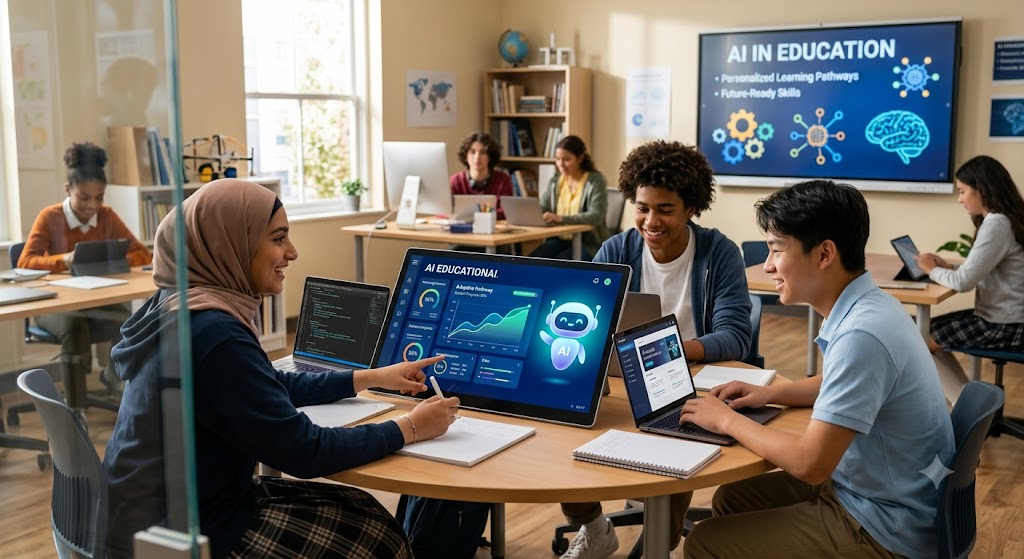
AI in education today look nothing like they did a decade ago, and the transformation is accelerating every single year. Schools, universities, and online learning platforms are rethinking how they teach, assess, and support students, and the driving force behind this shift is artificial intelligence. From personalized lesson plans to automated grading, AI in education is reshaping how knowledge is delivered and absorbed, making learning more efficient, inclusive, and outcome-driven than ever before.
This article breaks down ten powerful ways this technology is changing classrooms, campuses, and online courses, along with real-world examples, key benefits, and practical insights into how far this trend can scale. Whether you’re an educator, a parent, a student, or an edtech entrepreneur, understanding how AI in education works will help you stay ahead in a rapidly evolving learning landscape. We’ll also look at the challenges that come with this shift, so the picture stays balanced and realistic rather than purely promotional.
AI in education in this space isn’t limited to K-12 schools either. Corporate training departments, coding bootcamps, language-learning apps, and even test-prep companies have all folded similar technology into their products, which means the impact of this shift extends well beyond traditional classrooms into lifelong and professional learning as well.
Why This Shift Matters Right Now
Traditional teaching methods were built for a one-size-fits-all model, but every learner absorbs information differently. Some need more time on a concept, others need visual aids, and many simply need encouragement at the right moment. Intelligent systems can now analyze how a student learns and adjust content delivery instantly, something no single teacher could realistically do for thirty students at once. This is why so many school districts, from small rural systems to large urban networks, are investing heavily in these tools rather than treating them as optional extras.
The pandemic years accelerated remote and hybrid learning adoption, and many of the digital habits formed during that period never fully disappeared. Students grew accustomed to on-demand explanations, instant quizzes, and digital dashboards showing their own progress. That expectation has carried forward, pushing schools to keep investing in smarter, more responsive tools even as in-person classes have resumed.

Investment figures reflect this momentum clearly. Ed-tech spending tied to AI in education has climbed steadily across both public school budgets and private venture funding, signaling that this isn’t a temporary trend but a structural shift in how learning gets funded and delivered. Administrators who once viewed these tools as experimental add-ons now treat them as core infrastructure, on par with textbooks or internet access, when planning annual budgets.
1. Personalized Learning Paths for Every Student
One of the most talked-about benefits of intelligent classroom tools is personalized learning. Instead of forcing every student through the same pace and sequence of lessons, smart systems track individual progress and adapt content accordingly. A student struggling with fractions might get extra practice problems, while a student who’s already mastered the topic moves ahead to more advanced material. This approach keeps learners engaged rather than bored or overwhelmed, and it’s one of the clearest examples of how AI in education creates a more human-centered classroom, ironically, through automation.
Key points:
- AI in education
- Content difficulty scales up or down based on performance
- Reduces frustration and boosts confidence over time
- Encourages self-paced mastery instead of rigid deadlines
Beyond academic pacing, personalization also extends to learning style. Some students absorb information better through video, others through text or interactive diagrams. Modern platforms can detect which format produces better retention for a given student and lean into that format more heavily going forward, something a printed textbook could never do.
2. Adaptive Learning Platforms That Evolve With Students
Adaptive learning platforms go a step further than basic personalization by continuously reshaping the entire curriculum path based on real-time performance data. Platforms like DreamBox, Knewton, and Squirrel AI use algorithms that study thousands of data points to predict what a student needs next. This isn’t a static lesson plan; it’s a living system that evolves as the learner grows, ensuring that students never feel stuck on outdated material or pushed too fast into concepts they aren’t ready for.
Example: A math platform notices a student consistently makes errors in word problems but excels at pure calculation. It automatically inserts targeted word-problem exercises without slowing down the student’s progress elsewhere.
These AI in education also help teachers plan group activities more effectively. Instead of guessing which students should be paired together for peer learning, dashboards can suggest groupings based on complementary strengths and weaknesses, turning data into practical classroom strategy rather than abstract numbers on a screen. This kind of continuous adaptation is a strong example of AI in education working quietly in the background, rather than as a flashy, front-facing feature.
3. AI-Powered Tutoring That’s Available 24/7
AI in education every student has access to a private tutor, but AI-powered tutoring tools are closing that gap. Chatbot-based tutors and virtual assistants can answer questions, explain concepts in multiple ways, and provide instant feedback at any hour of the day. This round-the-clock availability means students aren’t stuck waiting until the next school day to get help with a confusing homework problem, which has been a game-changer for students in remote areas or those juggling part-time jobs alongside their studies.
Advantages:
- No scheduling conflicts or waiting lists
- Judgment-free environment for asking “basic” questions
- Consistent explanations tailored to the student’s level
- Lower cost compared to hiring a human tutor for every subject
For a lot of households where weekly tutoring once fell outside the budget, these tools have become the go-to option for everyday academic help, with human tutors brought in only when the subject matter gets more advanced or requires specialized expertise. This layered approach, technology first and human expertise where it matters most, is proving to be both practical and financially sustainable for households on tighter budgets. Surveys of parents consistently show growing comfort with AI in education as a supplement to, rather than a substitute for, traditional homework help.
4. Automated Grading and Faster Feedback Loops
Grading essays, quizzes, and assignments used to eat up hours of a teacher’s week. Now, automated grading systems can evaluate multiple-choice tests instantly and even assess short written responses using natural language processing. This doesn’t just save time; it means students get feedback while the material is still fresh in their minds, rather than a week later when they’ve already moved on mentally. Teachers, meanwhile, can redirect that saved time toward actual instruction and one-on-one student support.

Example: Tools like Gradescope and Turnitin’s AI feedback features help instructors grade hundreds of essays for structure, grammar, and argument clarity in a fraction of the usual time.
It’s worth noting that most educators still review flagged or borderline cases manually, using automation as a first pass rather than a final verdict. This hybrid approach preserves fairness while still delivering the speed benefits that make large classes manageable for a single instructor. Skeptics initially worried that AI in education would mean impersonal, robotic feedback, but most current tools are designed to flag issues for teacher review rather than issue final grades unsupervised.
5. Smart Classrooms With Real-Time Engagement Tracking
Smart classrooms equipped with sensors and analytics tools can now monitor engagement levels during lessons, flagging when students seem confused, distracted, or disengaged. Teachers receive dashboards showing which parts of a lecture caused the most confusion, allowing them to revisit tricky topics before moving forward. This real-time feedback loop between technology and teaching represents one of the more practical applications available today, turning guesswork into data-backed classroom decisions.
Key points:
- AI in education
- Reduces reliance on end-of-term evaluations alone
- Enables early recognition of learners who may need extra help before their difficulties grow
- Supports better lesson pacing during live instruction
Some universities have started using anonymized engagement data at the institutional level, comparing trends across different departments to identify which teaching styles resonate most with students campus-wide, informing broader training programs for faculty.
6. Predictive Analytics for Early Intervention
Predictive analytics tools analyze attendance patterns, grades, and engagement history to flag students who might be at risk of falling behind or dropping out entirely. Instead of waiting for a failing grade to trigger concern, schools can intervene weeks or even months earlier with tutoring, counseling, or adjusted coursework.Institutions such as Georgia State have applied data-driven forecasting tools to boost completion rates, flagging red flags well ahead of time so that issues can be addressed before they turn into serious setbacks
Advantages:
- AI in education
- Enables proactive rather than reactive support
- Improves overall retention and graduation rates
- Helps allocate counseling resources more efficiently
Such alert systems tend to be particularly beneficial for first-generation students, since they often don’t have the same informal networks that help their peers notice when academic struggles are setting in, or emotionally before it’s too late. Advocates of AI in education often point to these retention gains as some of the most measurable, dollar-for-dollar returns on ed-tech investment that institutions can point to.
7. Virtual Learning Assistants Supporting Teachers
Teachers wear a dozen hats every single day, from lesson planning to administrative paperwork. Virtual learning assistants now help lighten that load by drafting lesson plans, generating quiz questions, summarizing reading materials, and even suggesting differentiated activities for students with varying skill levels. This support doesn’t replace the teacher’s expertise; it simply frees up mental bandwidth so educators can focus on the parts of teaching that require genuine human connection and judgment.
Example: A teacher can ask a virtual assistant to generate five reading comprehension questions at three different difficulty tiers in under a minute, a task that would otherwise take twenty minutes of manual work.

AI in education burnout has become a serious concern in the profession, and administrative overload is frequently cited as a leading cause. Any tool that meaningfully reduces hours spent on paperwork and repetitive prep work has ripple effects on teacher retention, which ultimately benefits students through more experienced, less exhausted instructors. Union representatives and school boards alike have started citing AI in education as a genuine workload-management strategy, not just a classroom novelty.
8. Accessibility Tools for Students With Disabilities
AI in education one of the most meaningful applications of intelligent educational tools is in accessibility. Text-to-speech, speech-to-text, real-time captioning, and assistive technology powered by machine learning have opened doors for students with visual impairments, hearing difficulties, dyslexia, and other learning differences. These tools don’t just accommodate disabilities; they often unlock entirely new ways for students to engage with material that previously felt inaccessible, leveling the playing field in classrooms worldwide.
Key points:
- Real-time captioning supports hearing-impaired students
- Text-to-speech helps students with dyslexia or visual impairments
- Customizable interfaces reduce sensory overload for neurodivergent learners
- Speech-to-text tools help students who struggle with handwriting or typing
Parents of students with disabilities frequently report that these tools have reduced the need for constant one-on-one aide support in certain tasks, giving their children more independence in the classroom and a stronger sense of academic confidence. Disability advocacy groups increasingly view AI in education as one of the strongest arguments for continued, sustained ed-tech funding, since the impact on daily student independence is so directly measurable.
9. Data-Driven Curriculum Design
AI in education development used to rely heavily on intuition and slow feedback cycles spanning entire semesters or years. Now, data-driven insights allow schools and course creators to see exactly which lessons work, which ones confuse students, and which assessments actually measure understanding versus memorization. This shift toward evidence-based curriculum design is quietly one of the most impactful uses of AI in education, because it improves the actual content students receive, not just the delivery method.

Example: An online course platform notices that 40% of students drop off during a particular video lecture. The data prompts instructors to break that lecture into shorter, more digestible segments, improving completion rates significantly.
AI in education of digital textbooks are also using this kind of feedback loop to revise content mid-cycle, rather than waiting for the next annual edition, meaning students benefit from improvements almost as soon as problems are identified.
10. Immersive Learning Through AI-Enhanced Simulations
AI-enhanced simulations, including virtual labs and augmented reality experiences, are giving students hands-on practice without the cost or risk of physical materials. Medical students can practice surgical procedures in virtual environments, engineering students can test structural designs digitally, and history students can “walk through” reconstructed ancient cities. These immersive experiences make abstract concepts tangible, and they represent the cutting edge of what’s possible when classrooms embrace next-generation learning tools.
Advantages:
- Safe environment for practicing high-risk skills
- Makes abstract or historical concepts more tangible
- Cost-effective compared to physical lab equipment
- Repeatable practice without material waste or safety risk
Vocational training programs have been particularly quick to adopt these simulations, since trainees in fields like aviation maintenance or electrical work can practice on realistic digital models before ever touching expensive real-world equipment. This practical, hands-on side of AI in education is often overlooked in broader conversations that focus mainly on grading and tutoring, yet it may end up having some of the deepest long-term career impact.
Key Advantages Summarized
AI in education these ten applications together, the overall value of AI in education becomes clear: faster feedback, more personalized instruction, better accessibility, and data-backed decision-making at every level. Schools that adopt these tools thoughtfully tend to see improved student engagement, reduced dropout rates, and more efficient use of teacher time and resources. None of these benefits require replacing teachers; they require equipping teachers with better tools. When these systems are implemented well, the classroom becomes a partnership between human judgment and machine precision, each covering the other’s blind spots rather than competing for the same role.
Scaling Value: How Far Can This Trend Go?
AI in education of these tools is what makes them genuinely significant rather than a passing trend. A single well-designed adaptive learning platform can serve millions of students simultaneously, each receiving a customized experience without requiring millions of individual human tutors. As algorithms improve and become more affordable, even under-resourced schools in developing regions are gaining access to tools that were once exclusive to wealthy private institutions. The long-term potential for AI in education lies in this democratization: quality, personalized instruction becoming available to any student with an internet connection, regardless of their zip code or family income.

That said, scaling responsibly matters. Data privacy, algorithmic bias, and the risk of over-reliance on automated systems are real concerns that institutions must address as adoption grows. Regulatory frameworks around student data are still catching up in many countries, and schools need clear policies on how information is collected, stored, and used before rolling out new tools at scale. The most successful implementations treat these tools as a support system for human educators, not a replacement for them, and involve teachers directly in choosing and evaluating which tools actually serve their students well.
Final Thoughts about AI in education
AI in education of the future isn’t a distant concept anymore; it’s already taking shape in schools and universities around the world. From personalized learning paths to immersive simulations, these ten applications show just how deeply intelligent technology is reshaping education at every level. The institutions that thoughtfully integrate these tools, while keeping human connection at the center of teaching, will be the ones best equipped to prepare students for an increasingly complex world. As adoption grows, the schools that pair strong pedagogy with smart technology will likely set the standard for what effective, modern education looks like for years to come.
For educators and administrators considering where to start, the smartest approach is usually incremental: pilot one tool, measure its actual impact on student outcomes, gather feedback from both teachers and students, and expand only what genuinely works. Rushing to adopt every new tool on the market often leads to wasted budgets and tool fatigue among staff, while a measured, evidence-based rollout tends to build lasting trust and better long-term results for everyone involved. The next decade will likely bring even more refined tools, but the underlying principle will stay the same: technology should serve teaching, not the other way around.
Frequently Asked Questions
- What are the main benefits of using intelligent classroom technology in schools? The AI in education benefits include personalized learning paces, faster feedback through automated grading, early identification of struggling students, improved accessibility for students with disabilities, and more efficient use of teacher time.
- Is this technology replacing teachers? No. These tools are designed to support teachers by handling repetitive tasks like grading and administrative work, freeing educators to focus on mentorship, critical thinking development, and personalized student support that machines can’t replicate.
- How do adaptive learning platforms decide what content to show next? They analyze real-time performance data, including correct and incorrect answers, response time, and engagement patterns, to determine whether a student needs more practice, a different explanation style, or advanced material.
- Are these tools affordable for smaller schools or developing regions? Costs have dropped significantly as the technology matures, and many platforms now offer free or low-cost tiers, making these tools increasingly accessible to under-resourced schools and independent learners.
- What are the biggest risks or concerns with this shift in classrooms? Common concerns include student data privacy, potential algorithmic bias in assessments, and the risk of students or teachers becoming overly dependent on automated systems instead of developing independent critical thinking skills.
- Can these tools help students with learning disabilities? Yes, significantly. Text-to-speech, speech-to-text, real-time captioning, and customizable learning interfaces have made coursework far more accessible for students with dyslexia, visual impairments, hearing difficulties, and other learning differences.
- How should a school decide which tool to adopt first? Start with a clear problem rather than a trendy product. Identify whether the biggest need is grading time, student engagement, accessibility, or early intervention, then pilot a small-scale trial with measurable goals before committing to a full rollout across every classroom.