


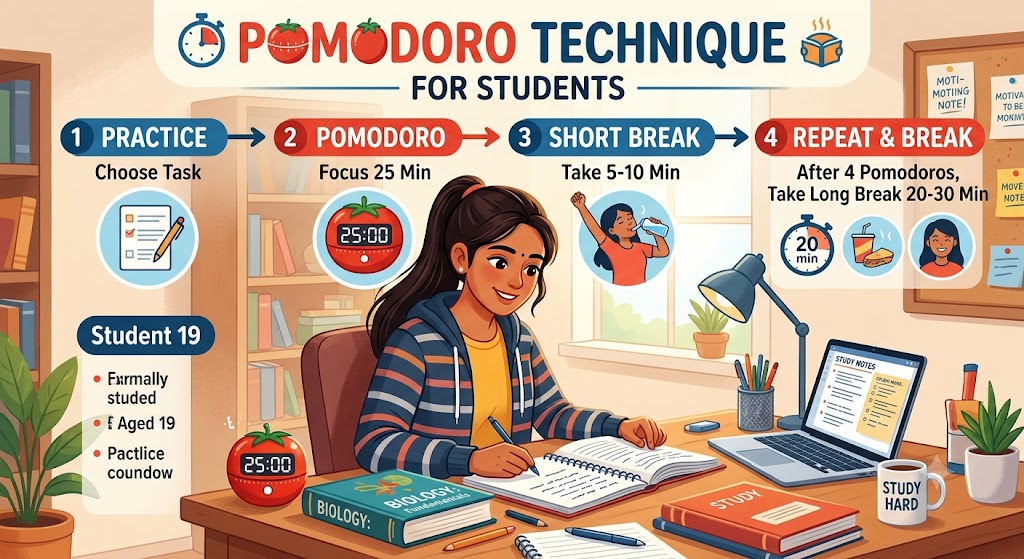
Pomodoro Technique for Students 2026: Study Smarter, Score Higher
The Pomodoro Technique for students in 2026 looks nothing like it did a decade ago. Between endless notifications, streaming platforms, group chats, and an ocean of online distractions, staying focused has become one of the hardest parts of academic life. This is exactly why the pomodoro technique for students has quietly become one of the most talked-about study methods among high schoolers, college students, and even competitive exam aspirants. It is simple, science-backed, and requires zero expensive tools — just a timer, a task, and the will to focus for a short burst of time.
This article breaks down everything you need to know about this method: what it is, why it works, how to apply it, real examples, its advantages, common mistakes, and how it scales for different types of learners. By the end, you will have a complete, practical roadmap to studying smarter — not harder — in 2026.

With more students now juggling online classes, part-time jobs, extracurricular commitments, and social pressures than ever before, finding a study method that is both flexible and reliable has never been more important. Traditional advice like “just focus harder” or “study more hours” rarely works in practice, because it ignores how attention, motivation, and energy naturally rise and fall throughout the day. That’s precisely the gap this method fills — it doesn’t ask for superhuman willpower, only short, repeatable bursts of effort supported by planned recovery time. This makes it accessible for a first-year student just learning how to manage independent study, as well as a final-year student trying to optimize every remaining hour before a major exam.
What Is the Pomodoro Technique?
The Pomodoro Technique for students is a time management method developed in the late 1980s by Francesco Cirillo, who used a tomato-shaped kitchen timer (pomodoro means “tomato” in Italian) to break his work into focused intervals. The core idea is simple: work for 25 minutes with complete focus, then take a 5-minute break. After completing four of these cycles, you take a longer break of 15–30 minutes.
For modern learners, applying the pomodoro technique for students means turning long, overwhelming study sessions into small, manageable chunks. Instead of sitting down to “study for three hours” — a task so vague it invites procrastination — a student commits to just one 25-minute focused study session at a time. This small shift in framing makes starting easier and finishing more satisfying.
Why the Pomodoro Technique Works in 2026
Our brains were not built to sustain deep focus for hours at a stretch, especially in an environment saturated with smartphones, social media, and constant digital noise. Cognitive science shows that attention naturally dips after 20–30 minutes of sustained mental effort. This is precisely why the pomodoro technique for students aligns so well with how the brain actually functions — it works with your attention span instead of against it.
Short, timed intervals also trigger a psychological phenomenon known as the Zeigarnik effect, where incomplete tasks stay more vivid in memory than completed ones. Because each Pomodoro session ends with a natural stopping point, students often find themselves eager to return to the next round rather than dreading it. Combined with structured short breaks for studying, this technique keeps mental fatigue low while keeping motivation high throughout the day.
Key Points of This Study Method
Before diving deeper, here are the essential building blocks every student should understand:
- 25 minutes of focused work, followed by a 5-minute break
- After 4 completed sessions, take a longer break (15–30 minutes)
- Each session is dedicated to one single task only
- Distractions (phone, social media, chats) are eliminated during work intervals
- Progress is tracked using a simple study planner or app
- The cycle is repeated throughout the day based on study goals

These key points form the foundation of the method, and once a student internalizes this rhythm, applying the pomodoro technique for students to different subjects — math, essay writing, revision, or exam prep — becomes almost automatic.
Step-by-Step Guide: How to Apply the Pomodoro Technique
Step 1: Choose One Task
Pick a single, clearly defined task — for example, “solve 10 algebra problems” or “read Chapter 4 of biology.” Vague goals like “study science” lead to confusion and wasted time.
Step 2: Set a Timer for 25 Minutes
Use a physical timer, your phone’s clock, or a dedicated app. During this window, the goal of the pomodoro technique for students is total, uninterrupted focus — no checking messages, no multitasking, no switching tabs.
Step 3: Pomodoro Technique for Students
Stay committed to the single task. If a distracting thought pops up (like remembering an errand), jot it down on paper and return to it later instead of acting on it immediately.
Step 4: Take a Short 5-Minute Break
Stand up, stretch, drink water, or look away from the screen. Avoid opening social media during this break, as it often extends far beyond five minutes and breaks your momentum.
Step 5: Repeat and Track Progress
After completing four Pomodoros, take a longer 15–30 minute break. Use a productivity tracker or checklist to visually monitor how many sessions you’ve completed — this small habit builds a strong sense of accomplishment over time.
Advantages of This Focused Study Method
Understanding the advantages helps students commit to this method with confidence and consistency.
1. Reduces Procrastination
Long study sessions feel intimidating, which is often why students delay starting altogether. Because the pomodoro technique for students breaks work into short, low-pressure intervals, beginning a task feels far less overwhelming.
2. Improves Concentration and Focus
By eliminating multitasking and committing to a single task per session, students train their brains to sustain deep focus for longer periods over time, gradually strengthening attention span.
3. Prevents Burnout and Mental Fatigue
Scheduled breaks ensure the brain gets regular recovery time, which helps maintain consistent energy levels across a full day of studying rather than crashing after just an hour.
4. Builds Better Time Management Skills
Structuring study time into countable sessions teaches students to estimate how long tasks actually take, a skill that carries over into exams, projects, and even future workplace productivity.
5. Increases a Sense of Accomplishment
Completing each 25-minute block gives an immediate feeling of progress, which builds momentum and motivation — especially useful during long revision periods before exams.
6. Works for Every Subject and Learning Style
Whether it’s memorizing vocabulary, solving equations, writing essays, or revising for board exams, the flexible structure adapts easily to nearly any academic requirement.
Pomodoro Technique vs. Other Popular Study Methods
Students today have access to dozens of productivity systems, so it helps to see how this method compares to other well-known approaches.

Pomodoro Technique for students: Marathon studying — sitting for 3–4 hours straight — often feels productive but usually results in declining comprehension after the first hour. In contrast, the pomodoro technique for students keeps information intake fresh by forcing regular recovery periods, which research links to better long-term retention.
Pomodoro technique for students: Time-blocking involves scheduling large chunks of your day for specific subjects, which works well for planning but doesn’t address in-the-moment focus. Pomodoro can actually be layered inside time-blocking — for example, a 2-hour block for math can be broken into four Pomodoro sessions, combining the benefits of both systems.
Pomodoro vs. Cramming: Cramming relies on last-minute, high-stress, low-retention study bursts. Because Pomodoro encourages consistent daily sessions using spaced repetition, it naturally reduces the need for panic-driven, ineffective cramming before exams.
Pomodoro vs. The 52/17 Rule: Some productivity experts recommend 52 minutes of work followed by a 17-minute break, based on research into the habits of highly productive employees. This can work well for older students or university-level learners who already have longer attention spans, while the classic 25/5 format remains better suited for younger students or difficult, dense subjects.
Who Should Use the Pomodoro Technique?
This method isn’t limited to one type of learner. It is especially useful for:
- Pomodoro Technique for students and struggle to start tasks
- Students with short attention spans, including those who get distracted easily by phones or social media
- Students juggling multiple subjects who need structured transitions between topics
- Students preparing for board exams or competitive tests, where consistency over weeks matters more than occasional long study sessions
- Remote and online learners who study without in-person supervision or accountability
Because it requires no special equipment, no cost, and almost no learning curve, virtually any student — from middle school to postgraduate level — can start using this system within minutes.
The Science Behind Focus, Breaks, and Memory Retention
Neuroscience research consistently shows that the brain consolidates information more effectively when learning is spaced out rather than absorbed in one continuous block. This is closely tied to a concept called spaced repetition, where reviewing material at intervals strengthens long-term memory far more than one long uninterrupted study session.
Additionally, short breaks give the brain’s default mode network time to process and organize newly learned information — essentially allowing the brain to “file away” what was just studied. This is one of the lesser-known but powerful reasons the pomodoro technique for students supports not just focus, but actual long-term academic performance, rather than just short-term productivity.
Real-Life Examples of the Pomodoro Technique in Action
Example 1: Exam Revision A 12th-grade student preparing for final exams divides each subject into 25-minute blocks — one Pomodoro for reviewing notes, another for solving past papers, and another for flashcard revision. By the end of the day, she has completed 10 focused sessions instead of one exhausting, unproductive six-hour marathon.
Example 2: Essay Writing A college student struggling to start a research paper uses one Pomodoro just to write an outline, another to draft the introduction, and another to find supporting sources. Breaking the intimidating task into small wins helps her finish the paper three days ahead of the deadline.
Example 3: Competitive Exam Preparation A student preparing for a competitive entrance test uses four Pomodoros each morning dedicated purely to timed problem-solving, followed by a longer break before switching subjects in the afternoon. This structured approach becomes central to his daily exam preparation routine.
These examples show how naturally the pomodoro technique for students fits into different academic goals, regardless of grade level or subject difficulty.
Best Tools and Apps for Pomodoro Study Sessions in 2026
Technology has made this method even easier to follow. Some popular tools students use in 2026 include:
- Forest – gamifies focus by growing virtual trees during study sessions
- Focus To-Do – combines Pomodoro timers with task lists
- Be Focused – simple, minimal timer for quick sessions
- Notion Pomodoro Widgets – integrates timers directly into study planners
- Physical kitchen timers – a distraction-free, screen-free option

Choosing the right digital study tool depends on personal preference — some students prefer screen-free methods to avoid phone-related distractions altogether. Regardless of which tool is chosen, the underlying principle behind the pomodoro technique for students stays the same: short, timed, distraction-free intervals of work followed by genuine rest. Apps simply make it easier to stay consistent by sending reminders, logging completed sessions, and visually showing daily progress, which can be especially motivating during long revision periods.
Common Mistakes Students Make (And How to Avoid Them)
Even a simple method can be misapplied. Here are frequent mistakes and how to fix them:
- Pomodoro Technique for students — this often extends breaks far beyond 5 minutes. Solution: keep your phone in another room.
- Multitasking within a single session — defeats the purpose of focused work. Solution: commit to one task per Pomodoro.
- Skipping breaks entirely — leads to burnout faster. Solution: treat breaks as non-negotiable, not optional.
- Setting unrealistic task goals — trying to finish an entire chapter in one session. Solution: break tasks into smaller, achievable chunks.
- Not tracking progress — makes it hard to stay motivated. Solution: use a simple checklist or app to log completed sessions.
Scalability: How the Pomodoro Technique Adapts to Every Student
One of the most valuable aspects of this method is its scalability. It works equally well whether you’re a school student studying for 2 hours a day or a university student managing a 10-hour study schedule during finals week.
- Beginners can start with just 2–3 Pomodoros a day to build the habit gradually.
- Intermediate learners can scale up to 6–8 sessions daily across multiple subjects.
- Advanced or competitive exam students often extend to 10+ sessions, adjusting interval lengths (e.g., 50-minute focus with 10-minute breaks) as their concentration improves.
This flexibility gives the method long-term value — students don’t need to abandon it as their workload increases; they simply scale the number and length of sessions to match their evolving academic demands. This scalable structure is a major reason the pomodoro technique for students continues to remain relevant across different education levels, from middle school to postgraduate study.
Long-Term Benefits Beyond Just Studying
While the immediate goal is better focus and higher grades, the habits built through this system tend to carry far beyond the classroom. Learning to break large, intimidating goals into small, timed actions is a transferable skill that applies to internships, part-time jobs, personal projects, and eventually full-time careers. Employers consistently value the ability to manage time, meet deadlines, and maintain focus in distraction-heavy environments — all of which are strengthened through consistent practice of this method during school or college years.
There’s also a mental health dimension worth mentioning. Structured, predictable study routines reduce the constant low-grade anxiety that comes from open-ended, unplanned work sessions. Knowing exactly how long a task will take, and knowing a break is guaranteed at the end of it, removes a surprising amount of daily stress. Over months and years, this can contribute to a healthier, more sustainable relationship with studying overall — one built on structure and consistency rather than last-minute panic and burnout.
Which Subjects Benefit Most From This Method
Not every subject responds to structured intervals in exactly the same way, and understanding these differences can help students get even more value from their sessions.

- Mathematics and Sciences: Short, focused bursts work well for solving problem sets, since sustained concentration is critical for multi-step calculations.
- Languages and Vocabulary: Frequent, shorter sessions throughout the day support better memorization than one long cramming block, aligning naturally with spaced repetition.
- Essay Writing and Humanities: Breaking writing into stages — outlining, drafting, editing — across separate sessions often produces clearer, better-structured work than writing everything in one sitting.
- Coding and Technical Subjects: Timed intervals help prevent the mental fatigue that comes from prolonged screen-based problem-solving, keeping logic and debugging sharp.
- Revision and Memorization: Repeated short sessions spread across several days consistently outperform single long revision marathons for long-term recall.
Tips to Maximize Results
- Study during your natural peak focus hours (morning or early evening, depending on your body clock)
- Keep a distraction-free study space with minimal noise and clutter
- Combine sessions with active recall and spaced repetition for stronger retention
- Reward yourself after completing a set number of sessions
- Adjust interval length based on subject difficulty — harder subjects may need shorter, more frequent breaks
Final Thoughts about the Pomodoro Technique for students
Studying effectively in 2026 isn’t about spending more hours with a textbook open — it’s about using that time with intention and structure. The pomodoro technique for students offers a simple, flexible, and proven framework that helps reduce procrastination, improve focus, and build sustainable study habits without burning out. Whether you’re preparing for a small quiz or a major competitive exam, breaking your work into focused intervals with regular breaks can transform how productive — and how confident — you feel about your studies. Start small, stay consistent, and let this method scale alongside your academic journey. The best part of this system is that it costs nothing to try — all it takes is a timer, one clear task, and twenty-five minutes of your undivided attention to see the difference for yourself.
Frequently Asked Questions (FAQs)
1. What is the ideal Pomodoro session length for students? The traditional format is 25 minutes of focused work followed by a 5-minute break, but students can adjust this to 30–50 minutes depending on subject difficulty and personal concentration levels.
2. How many Pomodoro sessions should a student do in a day? This varies by workload and goals. Beginners can start with 2–4 sessions daily, while students preparing for major exams may complete 8–12 sessions spread across the day.
3. Can the Pomodoro Technique help with exam anxiety? Yes. Breaking study material into small, manageable sessions reduces the feeling of being overwhelmed, which can lower stress and anxiety associated with large amounts of exam preparation.
4. Is the Pomodoro Technique suitable for group study? Yes, groups can sync their timers to study individually during focus sessions and discuss or clarify doubts during shared breaks, combining structure with collaboration.
5. What should students do during the 5-minute breaks? Simple activities like stretching, drinking water, walking briefly, or resting your eyes work best. Avoid social media, as it often leads to breaks running much longer than intended.
6. Pomodoro Technique for students Absolutely. Since online study often comes with more digital distractions, structured, timed sessions help students stay disciplined and accountable even without in-person supervision.
7. Can younger students use this technique too? Yes, though session lengths are usually shortened for younger learners — often 15–20 minutes of focus with proportionally shorter breaks — to match their natural attention span.
8. Do I need an app to follow this method, or can I use a regular clock? An app is not required at all. A simple kitchen timer, wall clock, or the timer built into any phone works perfectly well. Apps simply add convenience features like session tracking and reminders, but the core method works with any basic timing device.